C-DRONE GUIDE · 27 JANUARY 2026
Flying a drone at night: what French law says in 2026
Christmas lights, illuminated façades, shows, night-time works: demand for aerial images after dark keeps growing. But in France, night flying in the open category is prohibited by default. Here is the exact framework, the authorisation routes that actually exist, and what it means for your quote.
Aeronautical night: what are we talking about?
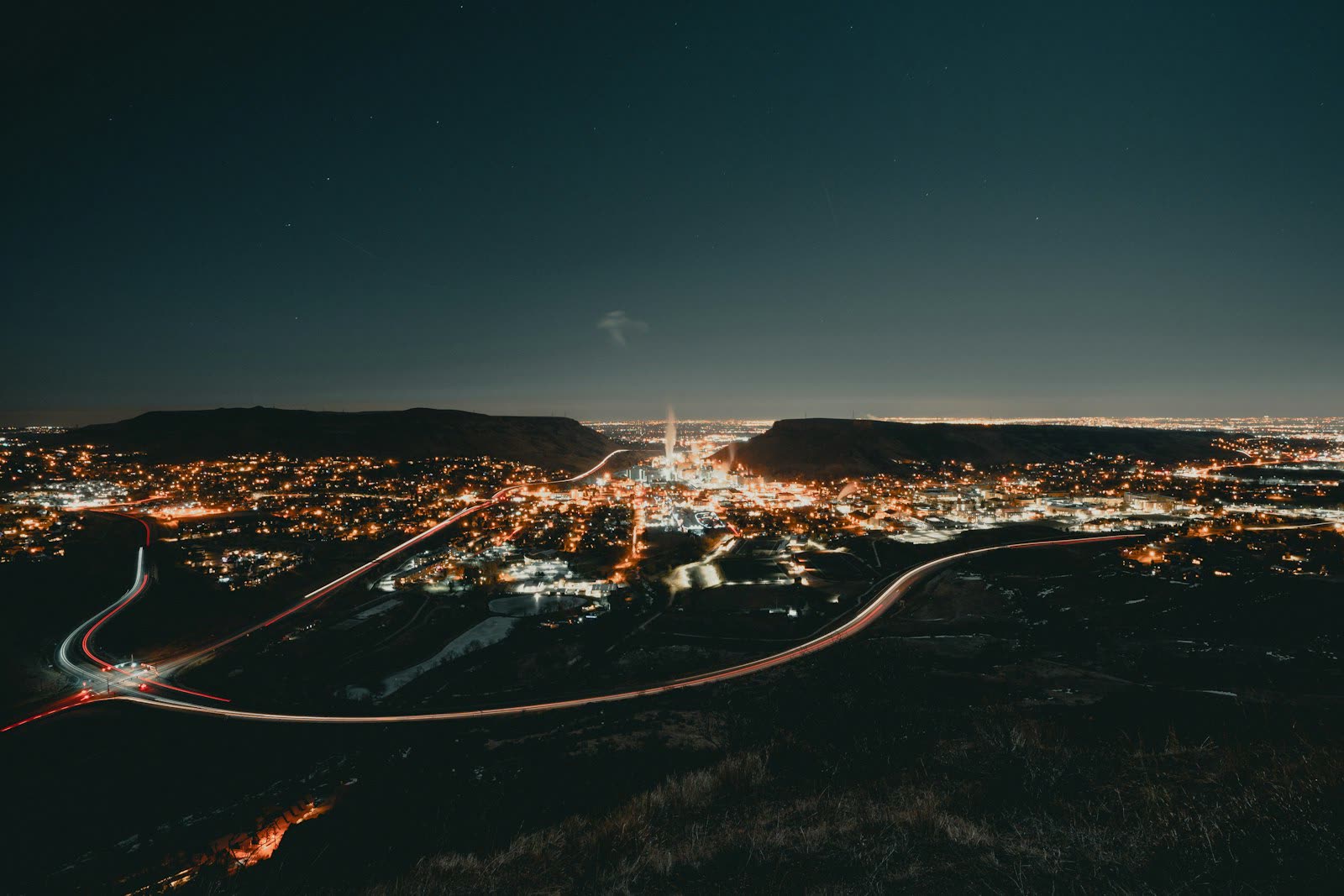
The regulations do not speak of "when it gets dark" but of aeronautical night: the period from thirty minutes after sunset to thirty minutes before sunrise. This definition has a valuable practical consequence: the evening blue hour — that moment when the sky is still bright but city lights are on — largely falls within the aeronautical day. A pilot taking off twenty minutes after sunset is legally flying by day, while capturing spectacular "night" images.
This is the profession's number-one trick, and it answers most requests: illuminated façades, dusk skylines, lit car parks and retail areas. In winter, with sunset around 5 p.m., the legal blue-hour window also falls at business-friendly times. Before launching a waiver procedure, always ask whether the image you want truly requires full darkness — eight times out of ten the answer is no, and the budget is halved.
Open category: the French default ban
European Regulation 2019/947 theoretically allows night flight in the open category, provided the drone carries a visible flashing green light. But France made a more restrictive choice: the French airspace order prohibits night flight of unmanned aircraft in the open category, save for a waiver — a rule maintained by the order of 23 December 2025, whose opening of urban public space to professionals expressly excludes night flying. In other words, what is allowed in Germany or Spain with a simple flashing light remains banned by default here — including in your own garden, including at two metres off the ground.
The waiver route exists: an application to the préfet of the département, examined with the opinion of the territorially competent civil aviation authority (DSAC). It is granted case by case, for a defined site, period and conditions (reduced height, clear area, lighting). Observed lead times run from three weeks to two months, and refusals are common in urban areas or near aerodromes. This procedure makes sense for recurring needs — a tourist site operator wanting night images every season — but rarely for a one-off, where the specific category or the blue hour are better options.
Specific category: the professional route to night flying
For professional operators, the specific category offers a more workable framework. The European standard scenarios STS-01 and STS-02 cover night operations, provided the pilot has completed the corresponding training and the drone carries a flashing green light distinguishing it from manned aircraft, in addition to the lighting the pilot needs to maintain visual contact. A night operation over a built-up area stacks the requirements: STS-01 declaration, prefectoral overflight declaration (ten working days), and night conditions.
In the field, night flying demands specific precautions the operator's manual must describe: a mandatory daytime site survey to map obstacles (cables, cranes and antennas become invisible at night), lighting of the take-off and landing area, an enlarged safety perimeter because bystanders can barely see the drone, and extra care with return-to-home — a badly set RTH descending into an unlit tree is the classic night accident. These constraints explain the premium: expect 30 to 60% more than an equivalent daytime job, typically €600 to €1,400 for an evening of night capture in 2026.
What remains off-limits, waiver or not
Some limits never fall, whatever night authorisations you hold. Overflying assemblies of people remains prohibited by night as by day: no drone above a concert crowd or a fireworks audience — the images are made from the periphery, with an angle that embraces the scene without flying over the public. Prohibited zones (airport surroundings without a protocol, sensitive sites, P areas) stay prohibited. And capture rules — privacy, GDPR — apply all the more because night amplifies how intrusive a drone feels: a thermal camera pointed at homes quickly falls under Article 226-1 of the Criminal Code.
Finally, be wary of "right above the fireworks" requests: beyond the crowd-overflight issue, incandescent fallout and the thermal turbulence of the launches make it a dangerous area for the machine itself. The spectacular fireworks shots you see online are filmed from a lateral distance, on a telephoto lens, from a clear area — it is safer, it is legal, and frankly it looks better too. A professional who accepts "anything, no problem" at night should trigger your suspicion, not your enthusiasm.
In practice: setting up a night-image project
The typical flow of a successful night project: first, a discussion of the desired image to determine whether the blue hour is enough — in which case the mission is planned like a standard day flight, simply timed against the ephemeris. If true darkness is essential (distant fireworks, event lighting, night works), the operator checks their framework: declared specific-category operator with night provisions, or a prefectoral waiver application where the context allows. Then allow three to six weeks of preparation.
Three questions to gauge how serious your provider is: "Under which regulatory framework will you fly at night?" (a vague answer is disqualifying), "When will you do the daytime survey?" and "What low-light equipment will you use?" — a fast-aperture Four Thirds or 1-inch sensor changes everything in night photography, and the best images often come from long exposures with the drone hovering, rather than video. Well prepared, a two-hour session through blue hour into full night produces visuals no daytime image can match: it stands out precisely because it is hard to do.