C-DRONE GUIDE · 16 JUNE 2026
Solar panels: why and how to run the annual thermal drone inspection
A photovoltaic installation loses money silently: a hot spot, a burned bypass diode or a disconnected string can cost 5 to 20% of production without triggering any alarm. Thermal drone inspection, now the standard preventive-maintenance tool, detects these faults in an hour of flight. Here is how it works, what it costs and what it pays back.
What the thermal camera sees — and the inverter does not
Inverter monitoring catches outright failures: a string at zero, an inverter in fault. But it is blind to diffuse degradation, which drowns in weather variability. That is where thermography comes in: a defective cell dissipates as heat the energy it no longer converts, and shows up on a thermal camera as a hot spot with a characteristic temperature delta. Each thermal signature tells a precise story: an isolated overheating cell (micro-crack, shading, encrusted soiling), an irregular checkerboard revealing PID (potential-induced degradation), a uniformly warm third of a module betraying a burned bypass diode, a whole module warmer than its neighbours signalling disconnection, or an overheating junction box — the most dangerous fault, as a precursor to fire.
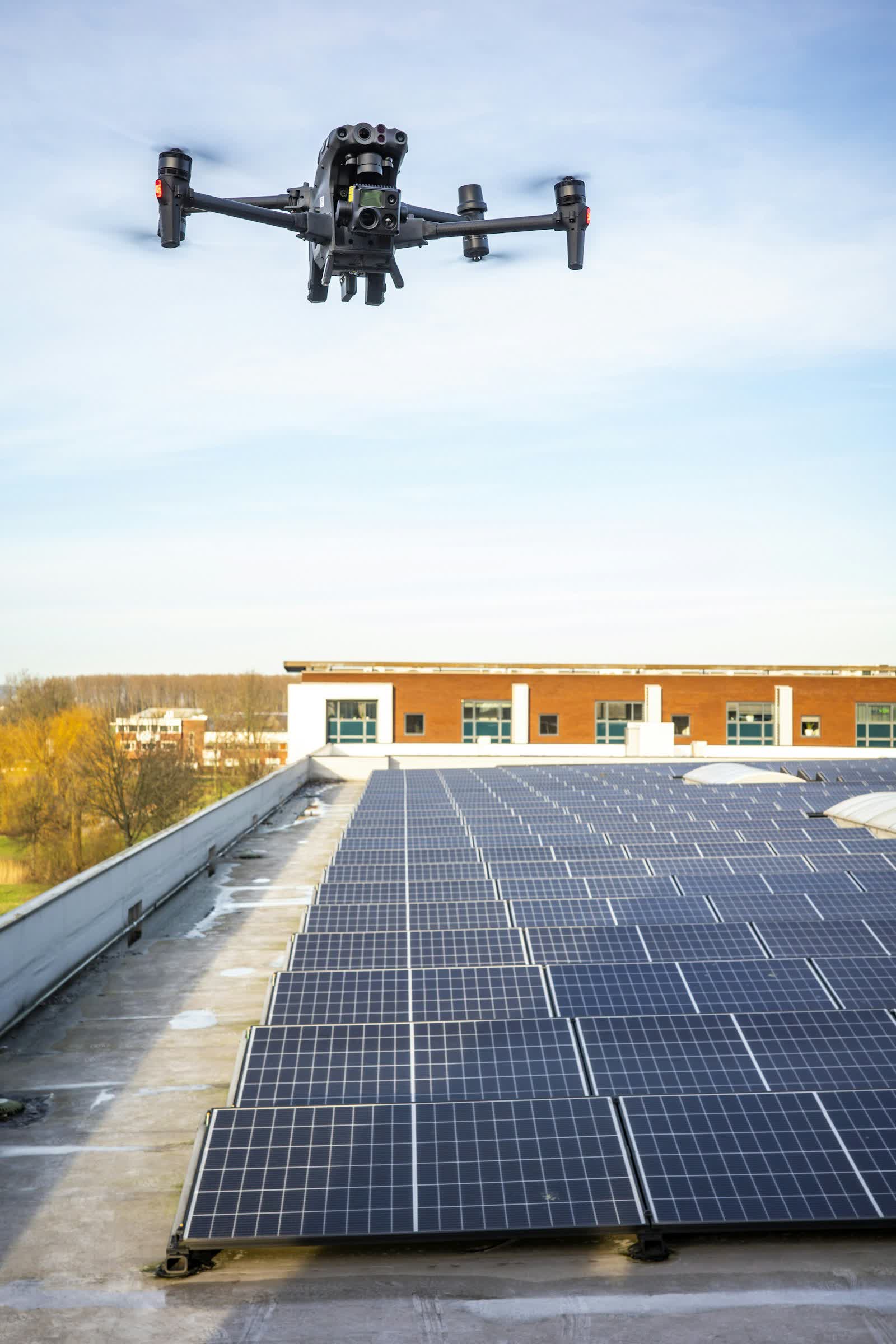
The drone flies the rows at 20-40 m with a radiometric thermal camera (measuring the true temperature of every pixel) paired with a visual sensor: the standard photo distinguishes a genuine electrical anomaly from mere bird droppings or a leaf, which also heat up. A ground-mounted plant of several hectares is inspected in a few hours of programmed flight, where a manual walk-through would take weeks — while missing the faults invisible from the aisle.
The conditions of a valid inspection
Photovoltaic thermography is only meaningful if the panels are working hard: the reference standard (IEC 62446-3) requires irradiance of at least 600 W/m² in the module plane — in practice, a clear day between late March and early October, in a 10 a.m. to 3 p.m. window. You also need a stable sky (passing clouds skew the readings), moderate wind that does not artificially cool the surfaces, and panels that are dry and reasonably clean. A provider offering thermography on an overcast November morning is selling a picture, not a measurement.
Add a regulatory requirement that is often overlooked: aerial capture outside the visible spectrum (thermal, infrared) remains subject to prior declaration in France, on top of the usual flight rules — open category above a private, unobstructed solar field, specific category if the roof is in a built-up area. Finally, the analysis demands a trained operator: thermography is riddled with false positives (sky reflections, sun glint, albedo differences) that an untrained eye mistakes for faults. Thermographer certification and an IEC 62446-3-compliant report are the right criteria for choosing a provider.
2026 prices: from house roof to ground-mounted plant
The French market has settled into three segments. For residential (3 to 9 kWp rooftop), inspection sells as a flat fee: €250 to €450 with report, often bundled with an inspection of the roof itself to share the call-out. For commercial, agricultural and carport roofs (36 to 500 kWp), expect €500 to €1,500 depending on area and access. For ground-mounted plants, pricing moves to per-kWp or per-megawatt: in the region of €1,000 to €2,500 per MWp depending on plant size, with volume discounts — large operators contract annual multi-site campaigns at tight rates.
The deliverable must detail: a map of defective modules with their exact position (row, column, serial number if layout drawings are provided), anomaly classification by type and severity per the standard, an estimate of the associated production loss, and intervention recommendations. Good reports put numbers on the stakes: "17 modules with diode faults, estimated loss 2.1 MWh/year, about €250" — it is this translation into euros that lets you choose between immediate replacement, grouped intervention at the next maintenance visit, or simple monitoring.
The payback: a quick calculation
Take a 100 kWp agricultural roof producing 110 MWh/year, sold at around €110/MWh — €12,000 of annual revenue. Field studies across European plants routinely find underperformance of 2 to 5% attributable to faults detectable by thermography. On the low assumption of 2%: €240 of annual loss, which persists and worsens as long as the fault goes unidentified. A €700 inspection every two years therefore pays for itself as soon as it finds any significant fault — and it almost always finds something, if only localised soiling whose targeted cleaning costs next to nothing.
Two stakes go beyond the production maths. Safety: overheating connectors and junction boxes are among the causes of photovoltaic fires, and their early detection is an argument insurers listen to — some commercial-roof policies now require periodic thermography. And warranty: most modules carry 12-to-25-year power warranties; a standard-compliant, dated, geolocated thermographic report is exactly the prima facie evidence that moves a warranty claim forward with the manufacturer. Conversely, discovering in year 13 a PID problem that set in during year 9 means an expired warranty and a dead loss.
Making the inspection an annual ritual
Thermography's value compounds with repetition. A one-off inspection photographs a state; an annual inspection, at the same dates and under the same protocol, measures a trajectory: has that hot spot worsened? Is the count of degraded cells growing faster than normal ageing (about 0.5% of power per year)? Seasoned operators schedule the campaign in May-June — strong sun, before extreme heat flattens the contrast — and add a post-event inspection after every hailstorm, since impact-induced cell damage is often invisible to the naked eye but glaring in thermal.
To make the ritual effortless: a multi-year contract with your drone provider, covering the flight under standardised conditions, the comparative report and the archiving of raw radiometric data (insist on it: it allows later re-analysis without re-flying). At C-Drone, these campaigns are planned from March to secure the May-June slots, with a free-postponement commitment if irradiance conditions are not met on the scheduled day. A solar installation is an asset that produces for thirty years; one hour of flight per year is a reasonable price for keeping that promise.