C-DRONE GUIDE · 1 MAY 2026
Thermal drones in agriculture: saving fawns before mowing
From May to June, meadow mowing coincides with roe deer births. Fawns, hard-wired to press flat against the ground and freeze, do not flee from the mower: tens of thousands die this way every year in France. Over recent seasons, a remarkably effective countermeasure has spread: flying a thermal drone over plots just before mowing. Here is how these operations work, how to get organised in your area, and what they really cost.
The silent tragedy of spring mowing
Roe deer does give birth between early May and mid-June, precisely in the tall grass of hay meadows, which offer cover and quiet. For its first three to four weeks, a fawn has a single survival strategy: total immobility. Its freezing instinct — pressing flat to the ground, ears down, without a movement — makes it undetectable to predators… and condemns it against a mower advancing at 15 km/h behind cutting bars several metres wide. It does not flee; it waits for the danger to pass. Estimates converge on tens of thousands of fawns killed each year in France, plus leverets, ground-nesting birds' broods and cats.
Nobody is at fault here, which is what makes it so frustrating: the farmer sees nothing from the cab — a fawn in tall grass is invisible from three metres away — and finding a mutilated animal in the swath is an experience livestock farmers dread, all the more since a carcass in the forage can contaminate silage (botulism) and threaten the herd. Traditional methods — walking the field the evening before, scarecrows, acoustic deterrents — mobilise many people for partial results: a walked search misses half the fawns, and deterrents do not scare off an animal whose very instinct is not to flee.
Why the thermal camera changes everything
A fawn is invisible in visible light, but it is a small 38°C furnace lying in the grass. A drone-mounted thermal camera makes it appear as a bright dot on a dark background, impossible to miss for an attentive operator. The decisive condition is thermal contrast: you must fly in the early morning, between dawn and 8 or 9 a.m., while the grass is still cool from the night. Once the sun warms the meadow, stones, molehills and tufts of dry grass start radiating and drown the animal's signal.
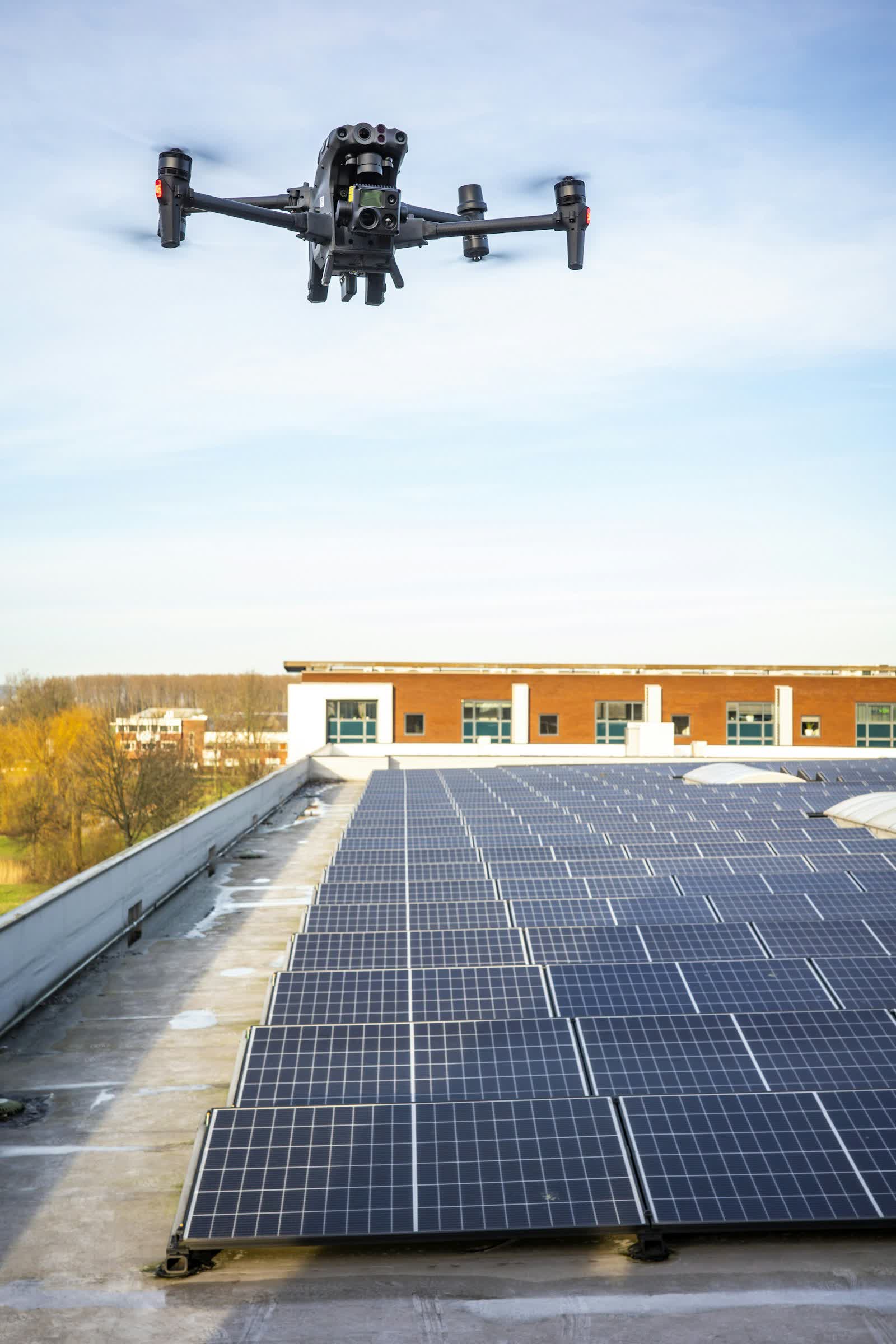
In practice, a drone with a thermal sensor flies the plot in parallel lines at 50 to 80 m, the way a mower traces its grid. At that height the observation swath covers 40 to 60 m and an experienced two-person team checks 8 to 12 hectares per hour, detections and verifications included. Every hot spot is inspected: the pilot descends, switches to the visible zoom camera, and tells a fawn from a hare, a cat or a still-warm molehill. Field results from the 2023-2025 seasons, in France as in Germany where the method is massively deployed, show detection rates close to 100% in good conditions — incomparable with any other method. It is, to date, the most spectacular cost-effectiveness case for thermal drones.
The protocol of a successful rescue
Everything starts with the farmer: they alert the drone team 24 to 48 hours before mowing — the single point that makes or breaks a whole season, because a fawn moved too early will be brought back into the plot by its mother. The flight happens on the morning of the mowing itself, or the previous evening as a last resort. The typical team is three people: a pilot, a camera operator, and at least one "carrier" on the ground guided by radio to each detection.
Handling the fawn follows strict rules, defined with hunting federations and the French biodiversity agency: never touch it with bare hands — human scent can cause abandonment — but with gloves and an armful of grass; place it in a ventilated, shaded crate set down at the field edge; log the GPS point; and release it at the same spot as soon as mowing ends, the doe returning for it within hours. Another validated option: leave it in place under an upturned, weighted crate, the mower going around the islet and the crate being removed after the work. Last link in the chain, the farmer adapts the mowing pattern: starting from the centre of the plot and mowing outwards gives mobile animals a chance to escape — the reverse of the usual direction, which traps them in the middle.
Who organises, who pays: the economics of equipped volunteering
Let us say it plainly: fawn rescue is not a market. The farmer earns nothing from it, and nobody bills this service at commercial rates. The model that has taken hold across France is equipped, organised volunteering: local rescue associations, departmental hunting federations, hunting societies, or professional drone pilots donating their May mornings — no client wants the 6 a.m. light anyway. Funding — grants, donations, sponsorship, federation budgets — goes to buying equipment and covering the teams' expenses.
The orders of magnitude to know when building a project: a drone with a suitable thermal sensor costs €4,000 to €15,000 depending on the class; a well-drilled team handles 3 to 6 plots per morning within a reasonable radius; observed expense reimbursements run from €0 to €150 per intervention, usually borne by the organisation and never by the farmer alone. For a professional pilot, joining these campaigns is no sacrifice: it is full-scale thermal training, a powerful local bond with the farming world — which is also a client base — and local visibility no advertising can buy. The skills involved are exactly those of professional drone thermography, applied to living animals.
Setting up an operation in your area: equipment and rules
Regulation-wise, these missions are among the simplest in the drone world: meadows outside built-up areas, daytime flight (aeronautical dawn is past by the useful hours of May-June), visual line of sight, moderate height. An open-category flight suffices in the vast majority of cases. The fundamentals still apply, volunteer or not: UAS operator registration on AlphaTango, appropriate pilot training, aerial liability insurance, and a check of local restrictions on the Géoportail map — some valleys stack low-level military zones and aerodrome surroundings. One wildlife-specific caution: repeated low flights over wild animals outside a rescue objective can constitute disturbance; you fly for the mission, not for the footage.
The roadmap for a first season: contact the departmental hunting federation and existing associations as early as winter — many départements already have a unit and mostly need hands and pilots; list volunteer farmers and collect provisional mowing dates; train the camera operator with drills (a rubber glove filled with hot water in the grass makes an excellent practice fawn); and rehearse the alert chain through a single messaging group. The season lasts only six weeks: whatever is not ready by late April will be missed by May's fawns.
And after the mowing? The thermal drone's other lives
Teams built for fawn rescue quickly discover their know-how serves all year round. The same drone, the same early-morning thermal contrast and the same grid method find a dog lost after a road accident, a cat missing for three days or a strayed herd — we devote a dedicated guide to it: finding a lost animal with a thermal drone. Federations also use these crews for nocturnal big-game counts, wild boar population estimates ahead of hunting plans, or locating injured animals after collisions.
For farmers, the pre-mowing thermal flight is often their first concrete encounter with the tool — and it calls for others: calving surveillance in pastures, game damage detection, and the whole field of precision agriculture by drone, from biomass mapping to plant counting. Fawn rescue thus plays a role nobody anticipated: it has become the best full-scale demonstration of what drones bring to the rural world — quiet, useful, and universally applauded. If a single drone operation had to win over a sceptic, it would be this one.